 comparison
Single Origin vs Blend Coffee Explained
Table of Contents
- Single Origin vs Blend Coffee: The Core Difference
- What Is a Coffee Blend?
- Benefits of Drinking Single Origin Coffee
- How to Brew Single Origin Coffee at Home
- Flavor, Consistency, and the 'Single Origin Blend' Paradox
- Sustainability and Traceability in Coffee Sourcing
- How to Choose Between Single Origin and Blend
- Frequently Asked Questions
Last Updated: October 4, 2026
Single Origin vs Blend Coffee: The Core Difference
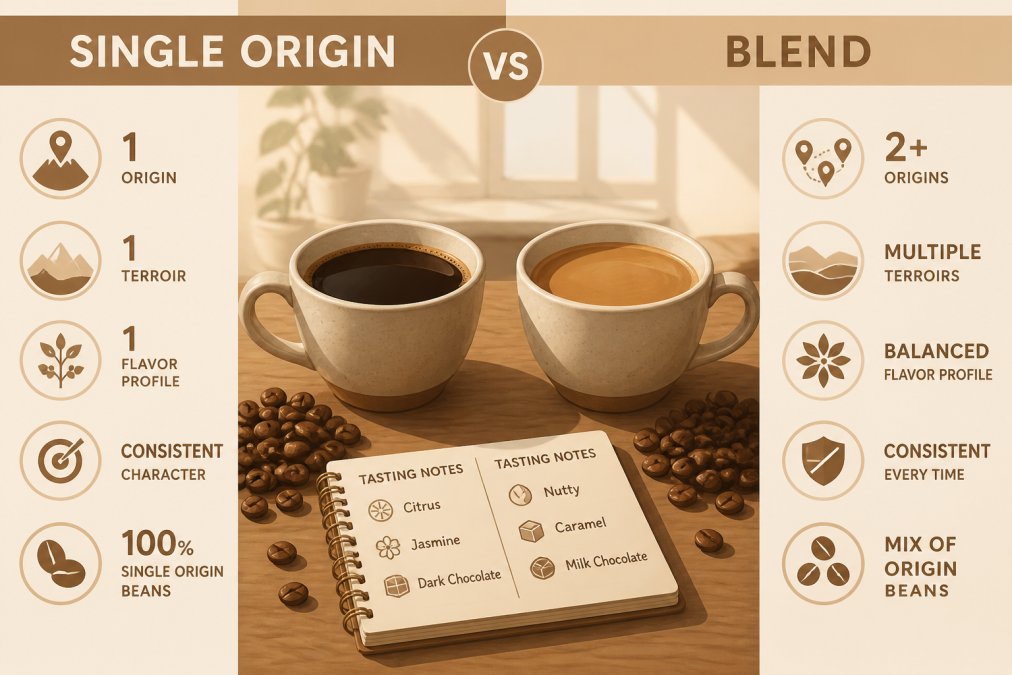
Single origin vs blend coffee explained comes down to one question: do you want a cup that tastes like a specific place, or a cup that tastes the same every single time? Single origin coffee comes from one farm, cooperative, or region. A blend combines beans from multiple origins to create a consistent, balanced cup. At Crazy Coffee Co, we roast high-potency single-origin Colombian beans, so we have a clear bias here. But we will also tell you exactly when a blend is the smarter buy.
That distinction matters more than most coffee marketing admits. The Specialty Coffee Association's coffee standards treats origin transparency as a core quality marker, and it shapes everything from flavor to price. Below, we break down how each type tastes, how to brew it, and which one fits your morning.
What Is a Coffee Blend?
A coffee blend is a mix of beans from two or more origins, roasted together to hit a target flavor profile. Roasters build blends for consistency, balance, and cost stability, so your cup tastes the same in January and July.
Why do roasters create blends? Three reasons:
- Consistency: A washed process bean from one harvest may shift year to year. Blending smooths those swings.
- Balance: One origin brings acidity, another adds body and notes of chocolate.
- Value: Blending ratios let roasters offset expensive micro-lot beans with reliable base lots.
The trade-off is provenance. Once beans are combined, traceability to a single estate or cooperative gets murky. That is the honest cost of a dependable cup.
Benefits of Drinking Single Origin Coffee
The main benefits of drinking single origin coffee are clarity and traceability. You taste one region's terroir, one bean variety, one processing method, with nothing hiding behind it.
Here is what you actually get:
- Distinct flavor profile: A Colombian washed bean tastes different from an Ethiopian natural. You can compare and learn.
- Sensory experience: Acidity, body, and mouthfeel become easier to notice when only one variable is in play.
- Traceability: You can often trace beans back to a single estate, cooperative, or micro-lot.
- Seasonal harvest character: Fresh crop beans carry flavors that fade once they are blended away.
Our single-origin Colombian roast is built for this. It is high-potency, so it fuels long workdays, and it skips the bitter, stale notes that come from old commodity coffee.
How to Brew Single Origin Coffee at Home
To brew single origin coffee at home, treat it like a delicate ingredient: use a medium grind, water just off boil, and a ratio around 1:16. Single origins reward precision because their flavors are exposed, not buffered by other beans. A blend forgives a sloppy grind; a single origin broadcasts it.
A simple starting method:
- Weigh 20 grams of coffee and 320 grams of water.
- Heat water to about 200°F, just below boiling.
- Bloom the grounds with 40 grams of water and wait 30 seconds.
- Pour the remaining water in slow circles over 2 to 3 minutes.
- Taste, then adjust grind before you adjust anything else.
Calibrating for Single Origin vs. Blend
Most brew guides stop at the recipe above. The real skill is knowing which dial to turn when the cup is off, and the answer differs depending on what is in the bag.
Single origin calibration:
- Grind: Start medium, then go finer in small steps. Bright, thin, or sour cups usually mean under-extraction, grind finer. Bitter, dry, or hollow cups mean over-extraction, grind coarser.
- Temperature: Delicate washed African lots often shine at 195-200°F. Drop the temp a few degrees if a bright coffee tastes harsh.
- Ratio: Start at 1:16. Push toward 1:15 for a heavier body, 1:17 for more clarity.
- Water: Soft water (roughly 50-100 ppm total hardness) lets origin flavors come through. Very hard water flattens acidity.
Blend calibration:
- Grind: Blends are more forgiving. A slightly coarser grind rarely ruins a cup built for balance.
- Temperature: 200-205°F works across most blends; the roast profile is designed to hold up.
- Ratio: 1:15 to 1:16 is a safe zone. Blends tolerate a wider range before they taste wrong.
- Water: Less sensitive. Standard filtered tap water is usually fine.
Espresso note: Blends are more forgiving on a home machine because their recipe is engineered for balance. Single origins can pull beautifully as espresso, but they demand tighter puck prep and a finer grind, expect to dial in more shots before you land one.
Cold brew note: Blends hold up better over long extraction because their components are already balanced. A single origin can taste flat or one-note after 12-16 hours; shorten the steep time if you brew one.
Flavor, Consistency, and the 'Single Origin Blend' Paradox
The "single origin blend" paradox trips up more shoppers than any other term in coffee. A bag can honestly say "single origin" while containing beans from a dozen farms, as long as every farm sits inside the same country or defined region. That is single origin by geography, not by estate.
Here is the distinction that actually matters at the shelf:
- Single-estate (or single-farm): Beans from one farm. The tightest traceability you can buy.
- Single-cooperative: Beans from one cooperative or washing station, often pooled from many smallholders. Still one origin, but multiple farms.
- Single-region / single-country: Beans from anywhere inside one country or growing region. This is where "single origin blend" legally lives.
- Multi-origin blend: Beans from two or more countries, combined to hit a target profile.
So a bag labeled "Single Origin Colombia" may be a blend of Huila, Nariño, and Cauca lots. It is not deceptive, it is a category label, not a farm label. The friction comes from shoppers assuming "single origin" means "one farm." It does not.
Why roasters do this: a single-country blend lets them hold a signature flavor year-round while individual micro-lots rotate with the harvest. You get regional character plus consistency. A true single-estate lot gives you the sharpest sense of place, but it disappears when the crop sells out.
How to read the bag:
- If the label names a farm, a producer, or a micro-lot, you are buying estate-level traceability.
- If it names only a country or region, expect a regional blend.
- If it lists two or more countries, it is a classic multi-origin blend.
| Factor | Single Origin (estate) | Single Origin (country/region) | Multi-Origin Blend |
|---|---|---|---|
| Flavor profile | Unique, place-specific | Regional character, more stable | Balanced, designed |
| Consistency | Varies by harvest | Moderate | Highly consistent |
| Traceability | Highest | Region-level | Lower once combined |
| Best for | Exploring flavor | Regional loyalty | Daily reliability |
| Roast consistency | Harder to hold | Moderate | Easiest to control |
Neither column wins outright. If you want a flavor that shifts with each harvest and traces to a named producer, go estate-level single origin. If you want the same balanced cup every morning, a multi-origin blend is the safer bet. If you want regional character without the lottery of micro-lots, a single-country blend sits in the middle, and that is the category most "single origin" bags on the shelf actually belong to.
Sustainability and Traceability in Coffee Sourcing
Sustainability and traceability metrics are where single origin usually pulls ahead. When beans come from one estate or cooperative, roasters can document the farm, the processing method, and often the price paid to growers.
Blends make this harder. Once lots are combined, tracing a specific bean back to a farm becomes difficult, and transparency often stops at the country level.
That does not make blends unethical. It means the burden shifts to the roaster. Ask three questions before you buy:
- Does the roaster name the farm, cooperative, or region?
- Is the processing method listed (washed, natural, or honey process)?
- Is the roast date printed on the bag?
If a bag answers all three, you are dealing with a sourcing-focused roaster. If it answers none, you are buying commodity coffee with better branding.
How to Choose Between Single Origin and Blend
Choose single origin if you want to taste a specific place and learn how terroir shapes flavor. Choose a blend if you want a dependable daily cup that tastes identical every time.
A quick decision framework:
- You are curious about flavor: single origin.
- You want zero surprises: blend.
- You brew espresso: blends are more forgiving, though single origins can shine as espresso too.
- You drink cold brew: both work, but blends hold up better over long extraction.
- You care about provenance: single origin, every time.
We built Crazy Coffee Co around the first path. Our single-origin Colombian beans and our Insomnia Blend are roasted for people who want sharp focus without the bitter, stale cup that office coffee trains you to accept.
Frequently Asked Questions
Is single origin coffee better than a blend?
Not necessarily. Single origin coffee highlights the unique flavors of one region, while blends are crafted for consistency and balance. Your choice depends on whether you prefer exploring distinct flavor profiles or having a reliable cup every time. Both can be high quality, so it comes down to personal taste and brewing method.
What are the primary flavor differences between single origin and blended coffee?
Single origin coffees often showcase terroir-driven notes like floral, fruity, or chocolatey flavors specific to their region. Blends combine beans to create a balanced cup with consistent acidity, body, and mouthfeel. For example, a single origin Colombian might have bright acidity and caramel sweetness, while a blend could mix Brazilian and Ethiopian beans for a smoother, nuttier profile.
Does single origin coffee always mean higher quality?
No. Single origin refers to the source, not the quality. A poorly processed single origin can taste worse than a well-crafted blend. Quality depends on factors like bean variety, processing method, roast consistency, and freshness. Look for specialty coffee labels and roast dates to ensure you're getting a superior product.
How does the roasting process differ for single origin versus blends?
Single origin beans are often roasted lighter to preserve their unique flavors, while blends may be roasted darker to achieve a consistent taste across different batches. Roasters adjust the roasting curve based on the bean's characteristics. For blends, the goal is to balance flavors; for single origins, it's to highlight terroir and acidity.
Most coffee drinkers never get past the label, and that is exactly why so many cups taste forgettable. If you want a roast that actually delivers, Crazy Coffee Co offers high-potency single-origin Colombian coffee and our Insomnia Blend, both built to eliminate bitter, stale brews and fuel your hustle. Get started with Crazy Coffee Co and make your next morning count.