 ultimate-guide
Order Fresh Roasted Coffee Beans 2026: A Buyer's Guide
Table of Contents
- Why 2026 Is the Year to Order Fresh Roasted Coffee Beans Online
- The Freshness Window: How Roast Date Beats Best-By Every Time
- Coffee Roast Date vs Expiration Date: What the Label Won't Tell You
- How to Keep Coffee Fresh Longer After Your Order Arrives
- Subscription vs One-Time Order: Which Fits Your Routine
- Reading the Bag: Specialty-Grade, Single-Origin, and Processing Method
- Conclusion: Build a Freshness-First Coffee Habit
- Frequently Asked Questions
Last Updated: September 18, 2026
Why 2026 Is the Year to Order Fresh Roasted Coffee Beans Online
Ordering fresh roasted coffee beans online has become standard practice for anyone serious about their morning cup, as more people discover the gap between grocery-shelf and roaster-direct coffee.
Freshness is a clock, not a label. Coffee starts losing its best qualities the moment roasting ends, and most supermarket bags were roasted months before you see them. Ordering fresh roasted coffee beans from a roaster resets that clock.
Below: the freshness window, the science of degassing, and how to evaluate any bag before you buy.
The Freshness Window: How Roast Date Beats Best-By Every Time
The freshness window for whole bean coffee is roughly 2 to 6 weeks after the roast date, depending on roast level and storage. A best-by date tells you almost nothing about when it was roasted.
A roast date is the day beans left the roaster. A best-by date is a manufacturer's guess at when the product stops being acceptable, often set far in the future and unrelated to peak flavor. A bag stamped "best by 2027" could have been roasted in 2025.
Light roasts hold their character longer than dark roasts, which lose aromatic oils faster. Single-origin beans show this more clearly than blends because nothing masks the decline.
Degassing: Why the First 48 Hours Matter
Freshly roasted coffee releases carbon dioxide for days after roasting. This is degassing, and it's why a bag roasted yesterday can brew worse than one roasted a week ago.
During the first 48 hours, beans off-gas aggressively. Brewing immediately lets escaping CO2 disrupt water contact with the grounds, producing uneven extraction. Most roasters recommend waiting a few days after the roast date, letting beans rest in the bag with the one-way valve doing its job.
That valve lets CO2 escape without letting oxygen in.
The Science of CO2 Release
Roasting triggers chemical reactions, primarily the Maillard reaction and caramelization, that create hundreds of aromatic compounds and trap carbon dioxide inside the bean's porous cellulose structure. After roasting, that CO2 slowly escapes through the cell walls.
The rate of release depends on several factors:
- Roast level: Darker roasts degas faster, often peaking within 3 to 5 days. Light roasts may take 7 to 10 days to reach their flavor peak.
- Bean density: Higher-grown, denser beans (above 1,500 meters) hold CO2 longer than lower-grown beans.
- Processing method: Washed coffees degas more predictably than natural or honey-processed coffees, which retain sugars and oils that slow the release.
Why Degassing Matters for Different Brew Methods
Not every brew method is equally sensitive to CO2. Here's how degassing affects common brewing approaches:
| Brew Method | Sensitivity to CO2 | Ideal Rest Time After Roast |
|---|---|---|
| Espresso | Very high | 7-14 days |
| Pour-over | Moderate | 4-7 days |
| French press | Moderate | 4-7 days |
| Cold brew | Low | 2-5 days |
| Drip machine | Low | 2-5 days |
Espresso is most demanding: pressurized brewing amplifies any inconsistency. If beans are still degassing heavily, CO2 creates channeling, water finds paths of least resistance through the puck instead of extracting evenly, producing shots that taste simultaneously sour and bitter.
Many specialty roasters recommend resting espresso beans at least a week after roast, some 10 to 14 days for peak extraction. Pour-over and immersion are more forgiving: longer contact time and gentler agitation let CO2 escape without disrupting the brew as severely.
How to Tell If Your Beans Are Still Degassing
You don't need lab equipment to gauge degassing. A few observations will tell you:
- The bloom: Pour hot water over freshly roasted grounds and they swell and bubble vigorously, that's CO2 escaping. A weak or flat bloom suggests the beans have rested past their peak or were never very fresh.
- The bag: If it hisses when opened or the beans feel buoyant, they're still releasing gas.
- The taste: If your usual recipe suddenly tastes flat or hollow, the beans may have degassed past their flavor peak.
The One-Way Valve: Engineering Meets Freshness
The one-way valve is critical packaging engineering: it lets CO2 escape while preventing oxygen from entering. Without it, a sealed bag of freshly roasted coffee would inflate like a balloon, and in extreme cases, burst. With it, beans rest and degas without oxidizing.
When you order fresh roasted coffee beans online, check for a one-way valve. It signals a roaster who understands the chemistry of freshness and invests in packaging that protects it.
Coffee Roast Date vs Expiration Date: What the Label Won't Tell You
Coffee roast date vs expiration date is the most misunderstood labeling issue in the category. The roast date tells you when flavor peaked; the expiration date tells you when a company decided the product is no longer sellable.
A few practical rules for reading any bag:
- Roast date printed as a specific day: ideal, buy with confidence
- "Best by" only, no roast date: freshness unknown, proceed cautiously
- "Packed on" date: refers to packaging, not roasting, and is not the same thing
- No date at all: skip it
Specialty-grade roasters almost always print the roast date because their customers check.
Why Best-By Dates Exist (and Why They're Meaningless for Specialty Coffee)
Best-by dates are a product of grocery retail logistics, not coffee science. Large-scale roasters distribute through warehouses, distributors, and shelves, a process taking weeks or months, so a best-by date gives retailers a legal and practical window to sell without spoilage claims.
How to Evaluate a Roaster's Freshness Commitment
1. Roast date on every bag. Non-negotiable for specialty coffee. If a roaster doesn't print it, they're either not roasting frequently enough to know it, or they don't want you to.
When comparing two roasters, check the roast date on the bag you receive. If it's more than 5 days old when it arrives, the roaster's shipping or roasting schedule may not be optimized for freshness. A 2- to 4-day-old roast date on arrival is a strong sign of a freshness-first operation.
The Cost of Ignoring Roast Dates
Buying coffee without checking the roast date isn't just a flavor issue, it's economic. Pay $18 to $22 for a 12-ounce bag that arrives 6 weeks post-roast and you're paying premium prices for a product past its peak. That's not a bargain; it's a waste.
How to Keep Coffee Fresh Longer After Your Order Arrives
Keeping coffee fresh longer means controlling three enemies: oxygen, moisture, and heat. Get those under control and you extend the usable window considerably.
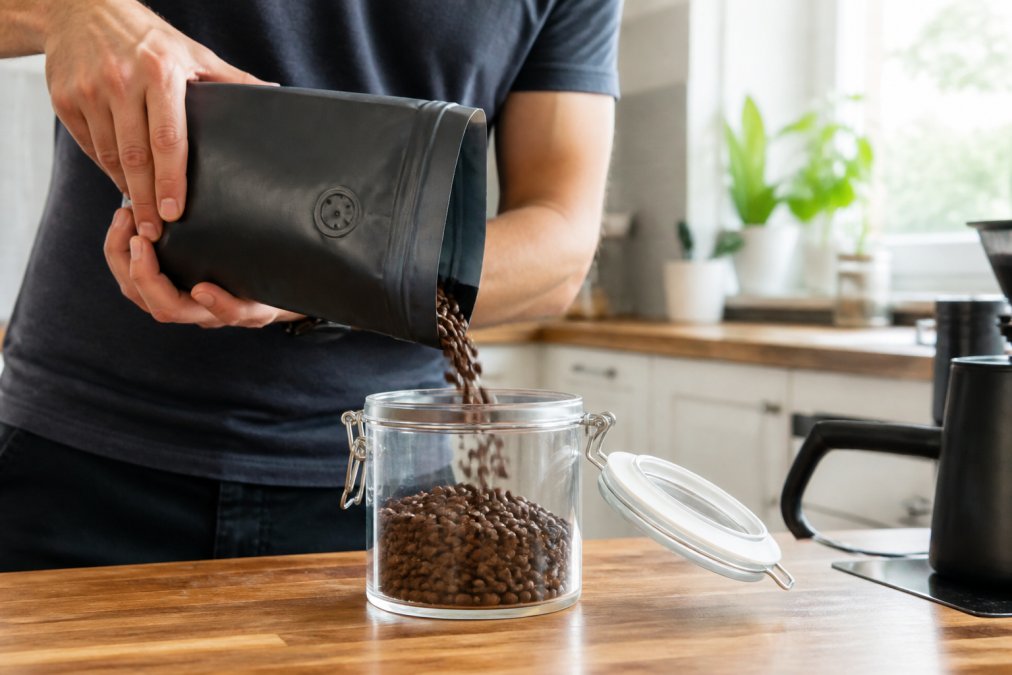
Storage Containers, Oxidation, and the Freezer Myth
An airtight container kept in a cool, dark cabinet is the standard recommendation. Oxidation, the reaction between coffee oils and oxygen, is what turns fresh coffee flat and stale, and a proper seal slows it dramatically.
Subscription vs One-Time Order: Which Fits Your Routine
A subscription works best for predictable drinkers who want steady supply without reordering. One-time orders suit irregular drinkers, roaster-rotators, or anyone who wants to try before committing.
Here's a quick way to decide:
| Your Situation | Best Option | Why |
|---|---|---|
| Daily drinker, same beans | Subscription | Arrives on schedule, always fresh |
| Weekend-only brewer | One-time, smaller bags | Avoids stale leftovers |
| Exploring roasters | One-time orders | Freedom to rotate |
| Busy professional | Subscription | Removes the reorder decision |
Reading the Bag: Specialty-Grade, Single-Origin, and Processing Method
Single-origin means the coffee comes from one specific place, often one farm, region, or micro-lot, letting the bean's natural character show through, which is why single-origin coffees have clearer tasting notes than blends.
Conclusion: Build a Freshness-First Coffee Habit
The hardest part of great coffee isn't technique or equipment, it's consistently getting beans still inside their freshness window when they hit your grinder.
Frequently Asked Questions
How long do fresh roasted coffee beans stay fresh after delivery?
Fresh roasted coffee beans hit peak flavor between 4 and 14 days after the roast date. After that, oxidation slowly flattens the aroma and acidity. Whole bean coffee keeps its character longer than pre-ground because less surface area is exposed to air. For best results, order only what you will brew within two to three weeks, and store beans in an airtight container away from light and heat.
What is the difference between roaster-direct and retail coffee?
Roaster-direct coffee ships from the roaster within days of roasting, so the roast date on the bag reflects when the beans were actually fired. Retail coffee often sits in warehouses and on shelves for weeks or months before purchase. When you order fresh roasted coffee beans from a roaster-direct source, you skip that delay and get beans inside the freshness window instead of past it.
Is it worth ordering coffee beans online versus buying in-store?
Online ordering usually wins on freshness because roasters ship immediately after roasting and print the roast date on every bag. In-store bags often carry only a best-by date, which tells you nothing about when the beans were roasted. If you value tasting notes, acidity, and aroma, ordering online from a roaster-direct seller gives you more control over how fresh your coffee actually is.
What should I look for on a coffee bag label to ensure freshness?
Look for a printed roast date, not just a best-by date. Check for the origin, processing method (washed, natural, or honey), and whether the beans are whole bean or pre-ground. A one-way degassing valve on the bag is a good sign the roaster understands freshness. If the label only shows a best-by date months out, you cannot tell how long the beans have been sitting.