 how-to
How Long to Steep Coffee in a French Press
Quick Summary
Steep coffee in a French press for about four minutes, which gives a balanced extraction for most medium roasts. Adjust in 30-second steps from there, changing one variable at a time. Use a 1:15 coffee-to-water ratio as your baseline.
- Start the timer as soon as all the water is in the french press
- Add 30 seconds if the cup tastes weak or flat
- Cut 30 seconds if the cup tastes bitter
- Steeping past five or six minutes often makes the cup muddy rather than bold
- Weigh coffee and water instead of relying on scoops for consistency
Table of Contents
- Recommended French Press Steep Time: Four Minutes as a Starting Point
- French Press Brew Time Chart: Steep Time and Flavor Compared
- How Many Scoops of Coffee for French Press and Why Dose Matters
- French Press Coffee-to-Water Ratio and Scaling Your Brew
- Step-by-Step French Press Brewing Method: Timing, Bloom, and Plunge
- How to Make French Press Coffee for One Without Guesswork
- Troubleshooting Your Steep: Fixing Weak, Bitter, or Muddy Cups
- Your Next Brew: Dialing In Steep Time on Your Own Setup
- Frequently Asked Questions
Recommended French Press Steep Time: Four Minutes as a Starting Point
Last Updated: November 7, 2026
If you're wondering how long to steep coffee in a French press, the most common answer is about four minutes. Four minutes gives a balanced extraction for most medium roasts, and it's a reliable baseline you can adjust from.
Steep time is the period when the coffee grounds sit in hot water before you press. Longer steeps pull more flavor out of the grounds. Shorter steeps leave the cup lighter and sometimes sour.
Start at four minutes, then change one thing at a time. If the cup tastes weak, add 30 seconds. If it tastes bitter, cut 30 seconds.
- Start the timer as soon as all the water is in
- Keep the lid on so heat stays in the carafe
- Press slowly and steadily, then serve right away
French Press Brew Time Chart: Steep Time and Flavor Compared
Different steep times produce noticeably different cups, but the chart only works if you read it as a starting map rather than a fixed rule. Use it to predict what a change will taste like, then confirm with your own brew.
| Steep Time | Likely Flavor | What to Adjust |
|---|---|---|
| 2 minutes | Light, sour, thin | Extend steep time by 30 seconds |
| 3 minutes | Bright, slightly weak | Add 30 seconds if flat |
| 4 minutes | Balanced and smooth | Good starting point |
| 5 minutes | Rich, slightly heavy | Shorten if bitter |
| 6+ minutes | Bitter, muddy, harsh | Shorten and check grind |
Why the curve bends. Extraction is front-loaded: the first two to three minutes pull most of the acids and sugars, and the later minutes pull more of the bitter compounds and fine solids. That is why going from three to four minutes often tastes like a bigger jump than going from four to five. Many brewers find the sweet spot for a medium roast sits between four and five minutes, and pushing past six minutes rarely makes a cup stronger in a pleasant way.
Worked example. Suppose your four-minute brew tastes bright but thin. Change one variable: steep five minutes with the same grind and dose. If it is now balanced, keep five minutes. If it turned bitter, your grind is likely too fine for that time, so go coarser and return to four minutes. This one-change-at-a-time loop is faster than guessing.
Grind and ratio shift the chart. A coarser grind extracts more slowly, so it may need five minutes to reach the same balance a finer grind hits at four. A stronger ratio (more coffee per ounce of water) can make a three-minute brew taste fuller, while a weaker ratio can make a five-minute brew taste thin. Treat the times above as defaults for a medium grind at roughly 1:15, and adjust the time only after you have set grind and ratio.
Watch out: Steeping longer does not always mean a stronger cup. Past five or six minutes, bitter compounds and fine particles can overpower the flavor, and the cup reads as muddy rather than bold.
A quick comparison method. Brew two small presses side by side at four and five minutes with everything else identical, then taste them back to back. Most people can identify the difference in under a minute, and that single comparison teaches you more about your own beans than any chart.
How Many Scoops of Coffee for French Press and Why Dose Matters
Dose is the amount of coffee you put in the press. Many people measure by scoop, but scoop size varies a lot between brands and tools.
For a standard 34-ounce French press, most people start with about 8 to 9 scoops of coarse-ground coffee. A scoop-based measure is easy to repeat, but a kitchen scale gives you more consistency from one brew to the next.
Dose affects strength as much as steep time does. Too little coffee makes a thin, weak cup, even with the perfect steep. Too much can taste heavy and bitter.
French Press Coffee-to-Water Ratio and Scaling Your Brew
A coffee-to-water ratio tells you how much water to use for each gram of coffee. Many brewers begin around 1:15, meaning 15 grams of water for every gram of coffee.
For a larger batch, keep the ratio the same and scale both amounts. For example, if you use 30 grams of coffee for a full press, use about 450 grams of water.
- Weigh your coffee and water when you can
- Keep the ratio fixed and change only one variable at a time
- Write down your settings so you can repeat a great cup
Step-by-Step French Press Brewing Method: Timing, Bloom, and Plunge
Follow these steps to brew a consistent cup. Each one affects the final flavor.
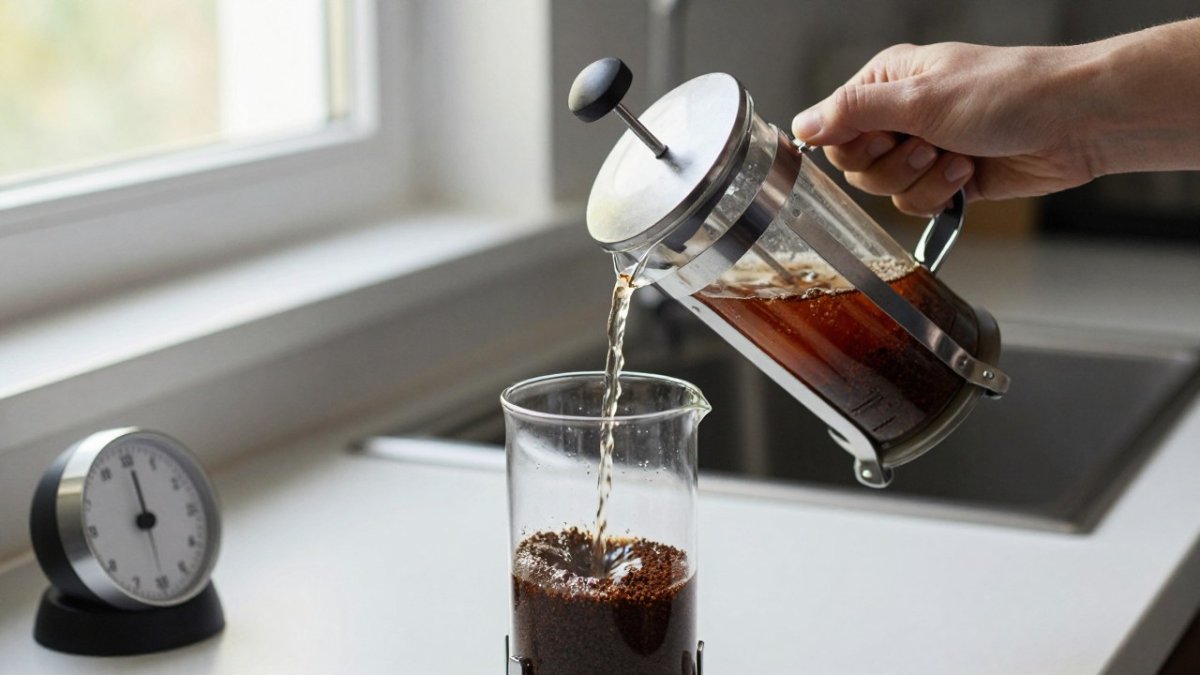
- Heat your water. Bring water to just off a boil, around 195 to 205 degrees Fahrenheit.
- Add coarse grounds. Pour the grounds into the press. Keep your mug hot through long sessions.
- Bloom the grounds. Pour a small amount of water over the grounds to wet them, then wait about 30 seconds while they release gas.
- Add the rest of the water. Pour the remaining water evenly over the grounds and start your timer.
- Steep. Wait your chosen time, usually about four minutes.
- Break the crust. Gently stir off the floating grounds and skim any foam.
- Plunge slowly. Press the plunger down steadily over about 15 to 20 seconds.
- Serve immediately. Pour all the coffee out of the press so it does not keep brewing.
Plunging too fast can push fine particles through the filter and make the cup gritty. Taking the time to plunge slowly keeps the cup clean.
How to Make French Press Coffee for One Without Guesswork
Brewing for one person is easy once you have a repeatable method. Use a smaller press or scale the recipe down.
For a single 12-ounce mug, try about 15 grams of coffee with 225 grams of water. Find high-potency single-origin beans roasted fresh for bold flavor. That keeps the 1:15 ratio and gives you enough coffee for a full cup.
Keep your timing the same as your full-size brew. Four minutes is a good start for one cup too, but check the taste and adjust.
Troubleshooting Your Steep: Fixing Weak, Bitter, or Muddy Cups
Most flavor problems trace back to steep time, grind, dose, or water temperature, and the fastest fix is a timed diagnostic loop rather than a random change. Work through the steps below in order, changing only one variable per brew.
Step 1: Identify the taste. Sour or weak usually means under-extraction. Bitter or harsh usually means over-extraction. Muddy or gritty usually means fine particles escaped the filter. Flat or inconsistent usually means measurement drift.
Step 2: Fix under-extraction (sour, weak). Add 30 seconds to your steep and brew again. If the cup is still sour at five minutes, grind finer by one setting and return to four minutes. If it is still weak at five minutes with a finer grind, increase dose by about 10 percent (for example, 30 grams to 33 grams on a full press).
Step 3: Fix over-extraction (bitter, harsh). Cut 30 seconds from your steep. If it is still bitter at three minutes, grind coarser by one setting and return to four minutes. If it is still harsh, check your water temperature: water above 205 degrees Fahrenheit can push bitterness even on a short steep, so let the kettle rest a minute after boiling.
Step 4: Fix muddy or gritty cups. Stir the crust gently before plunging and skim the foam, then press down over 15 to 20 seconds. If the cup is still muddy, your grind is too fine for the press filter, so go coarser. A second pass through the filter is not recommended because it cools the coffee and strips aroma.
Step 5: Fix flat or inconsistent results. Weigh coffee and water instead of using scoops, and write down grind, dose, temperature, and steep time for each brew. A common pattern is that two brews taste different because the scoop size changed between bags or the water was poured at a different temperature.
A timed troubleshooting path. Start at four minutes with a medium-coarse grind and a 1:15 ratio. Taste. If sour, go to 4:30. Taste. If still sour, grind finer and reset to 4:00. Taste. If bitter at any point, cut 30 seconds. This loop usually resolves the cup within three brews and gives you a written record you can repeat.
Watch out: Changing grind, dose, and time in the same brew makes it impossible to know which change fixed the cup, so resist the urge to adjust everything at once.
When to suspect the beans. If every brew tastes flat regardless of steep time, the coffee may be stale or the roast may be very dark, which extracts faster and turns bitter sooner. In that case, shorten the steep and use a coarser grind before changing anything else.
Your Next Brew: Dialing In Steep Time on Your Own Setup
Every press, grinder, and bean behaves a little differently. Use four minutes as your starting point, then fine-tune for your own setup.
Keep notes on your grind, dose, temperature, and steep time. Over a few brews, you will find the exact combination that tastes best to you.
Once your method is dialed in, fresh coffee makes a big difference. Try a bag from Crazy Coffee Co and see how your recipe performs.
Frequently Asked Questions
How long should you steep coffee in a French press?
Four minutes is the most common starting point for a French press. Coarse grounds at a standard ratio of about 1:15 steep well in that window. Shorter steeps around three minutes produce a lighter, brighter cup, while steeping up to five minutes adds body and bitterness. Start at four minutes, taste, and adjust by 30-second increments until the cup matches what you want.
Is 10 minutes too long to steep coffee in a French press?
Ten minutes is usually too long. After about five to six minutes, extraction keeps pulling bitter compounds and harsh flavors from the grounds, so the cup often tastes dull, heavy, or astringent. If you accidentally let it sit that long, plunge right away and pour the coffee into a separate carafe so it stops extracting.
Should you stir French press coffee while it steeps?
Stirring is optional but helpful. After you pour the water, the grounds float unevenly. Stirring once gently near the start of the brew breaks up dry clumps and makes extraction more even. Avoid stirring aggressively later in the steep, since it can disturb the crust and release fine particles that make the coffee muddy when you plunge.
Can coffee sit in a French press after plunging?
Coffee left on the grounds keeps extracting and can turn bitter within a few minutes. Once you plunge, pour all of the coffee out of the press into a serving vessel or thermal carafe. Drink it within about 30 minutes for the best flavor, since it cools and loses aromatics over time.